
Into an Author’s Work… Christian Kracht
In the series Into an Author’s Work…, we ask an expert on a body of work where to begin, how to move further into it — and, of course, why it’s worth the journey. In this article, Johan Lose, Programme Director at Bogforum, speaks with translator and Germanist Adam Paulsen about the Swiss author Christian Kracht.
- Frontpage
- Bogforum Magasin
- Into an Author’s Work… Christian Kracht
Christian Kracht
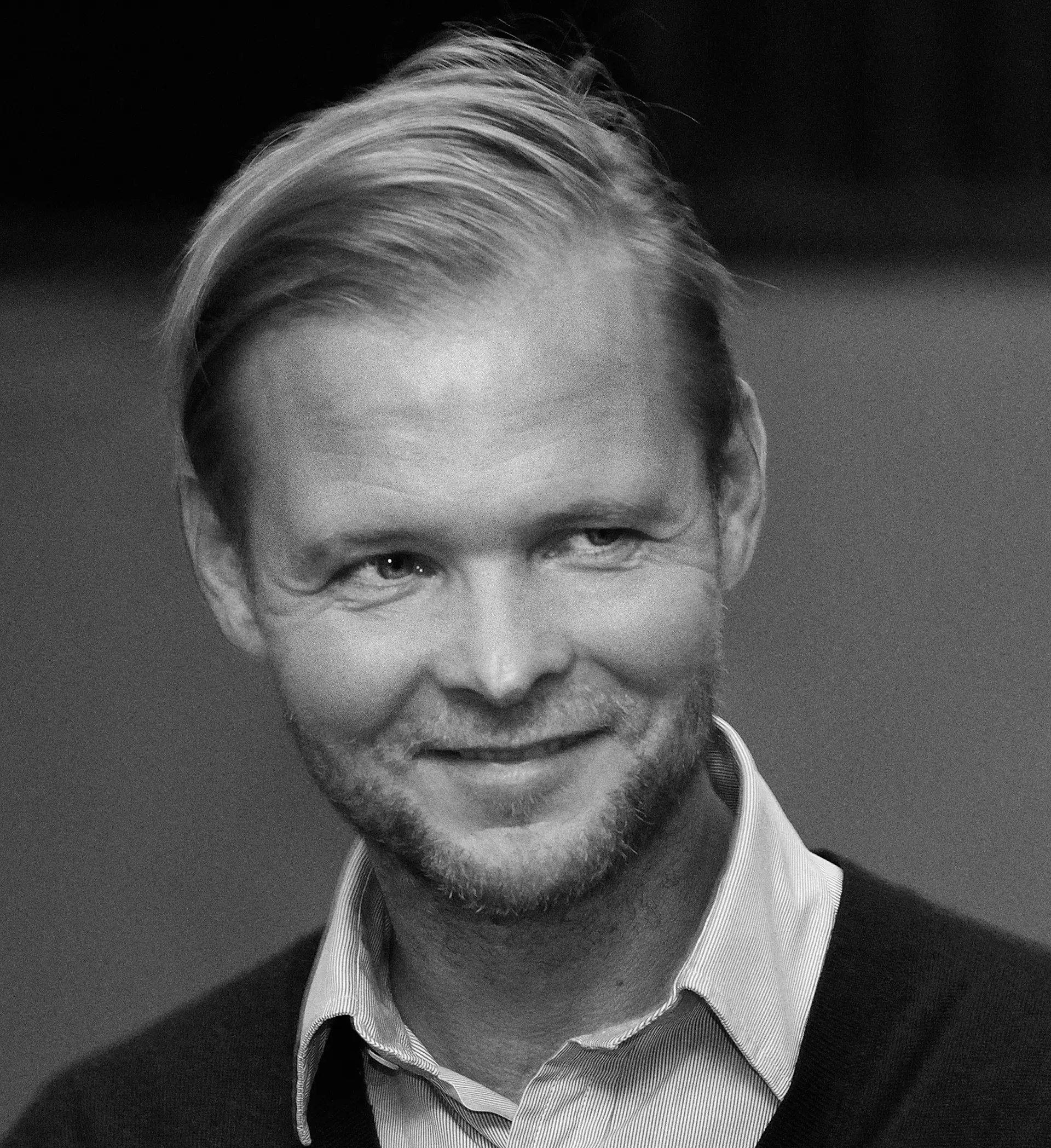
Christian Kracht
Christian Kracht was born in 1966 in Saanen, Switzerland. Since his debut novel Faserland (1995), widely regarded as a modern classic, he has established himself as one of the most important and distinctive European authors of his generation. Kracht’s background includes an upbringing in Switzerland, Canada, the United States and southern France, as well as extended stays in India, Thailand and Scotland — a breadth of experience that is reflected throughout his work.
In the novel Imperium (2012), Kracht tells the story of the German August Engelhardt, who at the beginning of the 20th century attempted to establish a religious nudist and vegan community in New Guinea. In The Dead (2016), he turns to 1930s Berlin and Tokyo, during the golden age of silent film. Also available in Danish is 1979 (2001), which centres on Iran on the eve of revolution, as well as the most recent, critically acclaimed novel Eurotrash.
What unites Kracht’s works is his ironic gaze, stylistic mastery, and his unflinching examination of the shadow sides and decadence of European history — themes that emerge most clearly in encounters with other cultures and other eras.
Photo: Noa Ben‑Shalom
I’d like to begin by asking how you discovered Christian Kracht. You were living in Berlin when he made his debut with Faserland (1995) — how was his arrival received in literary Germany?
Yes, I was living in Berlin when it was published, and I already knew of Kracht because he wrote for a rather cult‑like magazine called Tempo. He had been doing so for several years. Then this novel, Faserland, appeared and was quickly read as a generational novel. When I first read it, I wasn’t particularly enthusiastic. That came later, I have to admit.
Why only later?
Let me explain why I wasn’t immediately convinced. In Faserland, Kracht is clearly very influenced by Bret Easton Ellis, the author of Less Than Zero (1985) and American Psycho (1991). I had read those books myself with great enthusiasm, and all I could really see at the time was Kracht’s dependence on Ellis. I didn’t yet have a feel for the transposition of Ellis’s brutal, snobbish, cynical yuppie gaze into a German context — nor did I see what Kracht himself was adding.
What happens when that gaze meets a German context? I’m thinking of Germany in the mid‑1990s. Is that where the optimistic narrative of progress begins to lose momentum and feel hollow?
Yes, it’s a deeply disillusioned novel, with a dandyish first‑person narrator from the upper class who makes no attempt to conceal his contempt for the working class or the lower middle class. There is no social contract left, no consensus, no allegiance to the welfare state. It also represents a break with the moral, edifying literature that characterised much of West German post‑war writing and Vergangenheitsbewältigung. Think of names like Heinrich Böll and Günter Grass. In Kracht, there is no distinction between good and evil — everyone is simply “SPD Nazis,” as the narrator calls his fellow countrymen. Wildly provocative.
Today, Faserland has achieved classic status in Germany. Why is that?
It was one of the books that helped introduce pop literature in Germany — literature that appears to move on the surface, without psychological depth, deeply engaged with popular culture: clothing brands, music, films. Again, a borrowing from Bret Easton Ellis. Kracht’s command of language is also entirely unique. And it’s an incredibly funny book. But there is also a deeper, charged undercurrent — a melancholic tone. It’s a profoundly ambivalent novel.
Now that we’ve discussed Faserland, which hasn’t been translated into Danish, let’s move on to where Danish readers might enter Kracht’s work. Where should one begin?
I would say 1979. It’s a short novel that contains much of what defines a Kracht novel: a provocative longing for redemption, a fascination with and attraction to totalitarianism, a decadent aestheticism, and deep ambivalence. For instance, the protagonist ends up in a Chinese labour camp in a way that is genuinely ambiguous and difficult to decode. Is he appeasing the authorities when he says he has never felt better — or has he been brainwashed? The novel was published in 2001, right around 9/11, which naturally influenced its reception. It was read through the lens of the terrorist attacks — part of the narrative takes place in Tehran during the 1979 revolution, so political Islam appears in a menacing and deeply ambivalent way.
Returning to the provocative: for Danish readers, it might be difficult to understand why Kracht is considered so provocative in the German‑speaking world…
I think it has to do with his media presence, his authorial persona. When Faserland was published, it was read as autobiographical — as Kracht writing about himself. And he never really contradicted that. He simply smiled when asked. Of course, he draws on his own biography. Everyone knows he is, in fact, a rich kid. That’s not well received in literary circles, especially when one flaunts it, as he has at times.
All of his books also revolve around totalitarianism, but in an indeterminate, ambiguous way. He is fascinated by utopias and new forms of community. There is a deep tension between Huysmans‑like aesthetic decadence and a pull toward dangerous political adventures. It’s never clear where Kracht himself stands. Is it the author speaking, or the narrator? In interviews, he never tries to distance himself from that ambiguity.
Kracht clearly enjoys teasing. In Eurotrash, his most recent novel, he is repeatedly mistaken for another German‑language author, Daniel Kehlmann.
Yes, that’s actually quite funny — they definitely have a kind of game going between them, throughout their respective careers. There’s also something amusing about Kracht’s use of famous figures as cameos in his novels, often in highly questionable roles. In The Dead, for example, he turns Charlie Chaplin into a murderer by having him throw one of the main characters overboard from a cruise ship bound for the United States. And he gets away with it — no one even wonders what happens to the Japanese official who is simply expelled from the narrative because Chaplin takes offence at a sarcastic remark.
Here comes a slightly cheeky question: if one were to read only a single Kracht novel, which would you recommend?
I would say Imperium — but one should give it time, because it’s a complex novel. In a sense, it deals with the prehistory of the great civilisational rupture of the 20th century — the background to Nazism. The novel is set in the German Empire around 1900 and is viewed through the Lebensreform movement, a kind of proto‑hippie movement that emerged in reaction to the superficial materialism of the imperial era.
Kracht uses a historical figure, August Engelhardt, an eccentric who devised his own coconut gospel: one should eat only coconuts, which he believed to be the purest possible food. There’s something deeply unsettling in this. As we know, Hitler was a vegetarian and kind to animals — ideas he inherited from the Lebensreform movement. That movement led in many directions, but one of them was Nazism. That is the story Kracht tells — layered, complex, and endlessly rich. I’ve read Imperium three times and still discover new things. It’s a fantastic novel: funny, profound, provocative, and extraordinarily well composed.
My sense is that Kracht’s historical novels are always addressed to the present.
Absolutely. They can undoubtedly be translated into contemporary issues and debates. The longing for purity is a central theme throughout. But this is not literature that seeks to address political problems in any straightforward way. Kracht has been called an aesthetic fundamentalist, and there’s some truth in that. Aesthetics and art stand above politics — though that stance is itself political.
Is there a Kracht work that has had particular personal significance for you?
I’ve been deeply preoccupied with Imperium. Perhaps because I share Kracht’s fascination with its material: the many parallels between the Lebensreform movement around 1900 and our own time. The longing for purity and redemption, coupled with proto‑ecological thinking and utopian ideas, is incredibly compelling. I had been working with these themes before Imperium appeared. Kracht is something of a seismograph — I thought, “Okay, here I’m onto something others also find significant.”
Which work do you think will ultimately stand as Kracht’s major achievement?
I think Imperium will — but I also believe that Faserland and Eurotrash will endure, as a paired work. It’s quite remarkable that with Eurotrash, Kracht rewrites Faserland twenty‑five years later. Both novels begin in exactly the same way — with the word also. And astonishingly, they also end with the same word: bald. In both novels, the narrator seeks out the grave of a famous writer in Zurich: in Faserland, it’s Thomas Mann; in Eurotrash, Jorge Luis Borges.
In Faserland, there is a flight away from Germany — a constant discomfort with being German, never fully articulated, but clearly linked to Nazism and the German past. Switzerland appears as a place of intact order. In Eurotrash, the situation is reversed: Switzerland is relentlessly dismantled — cold, cynical, obsessed with money, portrayed as thoroughly complicit. It becomes almost Bernhardian. Yet Eurotrash also carries a different autofictional resonance, with greater pathos. One is constantly unsure how to read the relationship between the two novels.
One last aspect to touch on is the reception of a Kracht novel. Each new book is a major literary event. Why do you think that is?
Because his authorial persona is so fascinating and enigmatic. Because he plays so freely with genre and self‑staging, because he is provocative and unpredictable. In a way, he’s the Coen brothers of literature. Like them, he is deeply invested in genre and pastiche. Readers are curious about where his work will go next — what he has come up with this time. Quite simply, he also publishes infrequently: six novels over twenty‑five years is not much.
Final question, Adam. Can you recommend a work by another author that might sharpen one’s reading of Kracht?
There’s an interesting parallel in the way Faserland engages with American Psycho and Less Than Zero, and how both Bret Easton Ellis and Kracht have, around the same time, returned to the material of their early novels — Ellis with the excellent novel The Shards, published in Danish earlier this year. One could also read Daniel Kehlmann, who is widely translated into Danish. It makes sense, for example, to read Measuring the World alongside Imperium.